Answer each question, then reveal the correct answer and a full explanation. This is independent study material aligned to commonly tested topics, not official exam questions — exact content varies by state and exam vendor.
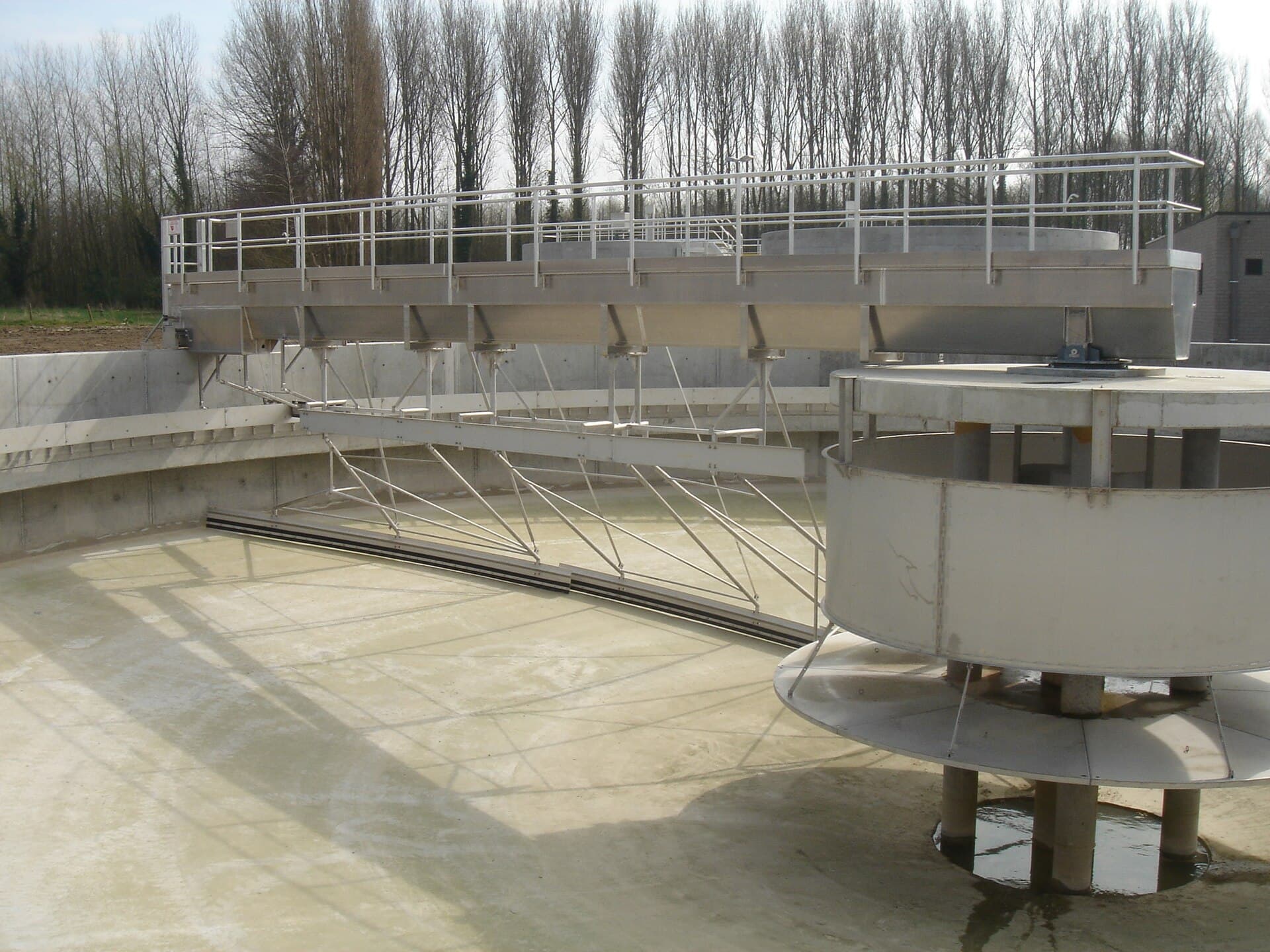
Photo: MADe, CC BY 3.0
Question 1Concept
What is the primary purpose of bar screens in preliminary wastewater treatment?
Question 2Math
A tank holds 50,000 gallons and receives a flow of 100,000 gallons per day. What is the detention time?
Question 3Concept
What is the primary purpose of grit removal in preliminary wastewater treatment?
Question 4Math
A primary clarifier has a surface area of 1,000 ft² and receives a flow of 1.0 MGD. What is the surface overflow rate?
Question 5Concept
Why is dechlorination often required after disinfecting wastewater effluent with chlorine?
Question 6Math
A plant receives a flow of 2.0 MGD with a BOD concentration of 220 mg/L. What is the BOD loading in lbs/day?
Question 7Concept
What is the main difference between primary and secondary treatment in a wastewater plant?
Question 8Concept
In the activated sludge process, what does a high sludge volume index (SVI) typically indicate?
Question 9Math
A 1-liter sample of mixed liquor settles to 250 mL after 30 minutes. The MLSS concentration is 2,500 mg/L. What is the SVI?
Question 10Concept
What is the primary function of the secondary clarifier following the aeration basin?
Question 11Math
An aeration basin receives 1,800 lbs/day of BOD and holds 3,000 lbs of MLVSS. What is the F:M ratio?
Question 12Concept
Which condition is generally required to promote nitrification (ammonia to nitrate conversion)?
Question 13Concept
What is the purpose of return activated sludge (RAS) in the activated sludge process?
Question 14Math
A trickling filter has a surface area of 2,000 ft² and receives a BOD loading of 100 lbs/day. What is the organic loading rate, in lbs BOD per day per 1,000 ft²?
Question 15Concept
What distinguishes Class A biosolids from Class B biosolids?
Question 16Math
An aeration basin and clarifier together hold 12,000 lbs of MLSS. The plant wastes 800 lbs/day of solids. What is the mean cell residence time (MCRT)?
Question 17Concept
A wastewater treatment plant exceeds its permitted effluent limit for BOD. What is the plant generally required to do under its NPDES permit?
Question 18Concept
Which method is most commonly used to remove phosphorus from wastewater beyond what biological treatment alone achieves?
Question 19Concept
For NPDES compliance monitoring, why might a permit require a 24-hour composite sample rather than a single grab sample?
Question 20Math
A plant wastes activated sludge (WAS) at a flow of 20,000 gpd with a solids concentration of 7,500 mg/L. How many pounds of solids are wasted per day?