Alkalinity
Read lesson →Water's ability to neutralize acid, usually reported as mg/L as calcium carbonate.
Operator context: Alkalinity affects pH stability, coagulation, corrosion control, and nitrification in wastewater plants.
Operator glossary
Definitions are grouped by how operators actually use them: treatment, distribution, wastewater, collection systems, safety, and math. When a term needs more than a quick definition, it links to a deeper lesson in the knowledge base.
Terms included
123
A single glossary keeps short definitions useful without turning every term into a thin page. Larger topics link into full lessons.
41 terms
Water's ability to neutralize acid, usually reported as mg/L as calcium carbonate.
Operator context: Alkalinity affects pH stability, coagulation, corrosion control, and nitrification in wastewater plants.
A way to express the oxidizing strength of a chlorine chemical.
Operator context: Operators use available chlorine when comparing disinfectants or calculating chemical feed.
The reverse-flow cleaning cycle used to remove trapped solids from a filter.
Operator context: Operators use headloss, turbidity, runtime, and plant procedures to decide when a filter needs washing.
A wall, curtain, or plate that directs flow and reduces short-circuiting in a basin or tank.
Operator context: Better baffling improves contact time, sedimentation, and hydraulic performance.
The point at which enough chlorine has been added to satisfy demand and leave a free chlorine residual.
Operator context: Operators use breakpoint concepts when ammonia or other reducing compounds consume chlorine before a stable residual appears.
The pattern of chlorine residual response as chlorine dose increases through demand and breakpoint.
Operator context: The curve helps explain why residual can drop before free chlorine appears.
A pump used to dose treatment chemicals at a controlled rate.
Operator context: Operators verify feed rate, calibration, solution strength, injection point, and backup equipment.
Combined chlorine compounds formed when chlorine reacts with ammonia.
Operator context: Chloramines last longer in distribution but disinfect more slowly than free chlorine.
The application of chlorine for disinfection or oxidation.
Operator context: Chlorination may be used in drinking-water treatment, distribution maintenance, wastewater disinfection, or main disinfection.
The amount of chlorine consumed by reactions with organic matter, ammonia, iron, manganese, and other substances.
Operator context: Dose minus residual equals demand, a common calculation and a daily operating check.
The measurable chlorine remaining after demand has been satisfied.
Operator context: Residual confirms disinfectant is still present in finished water or distribution lines.
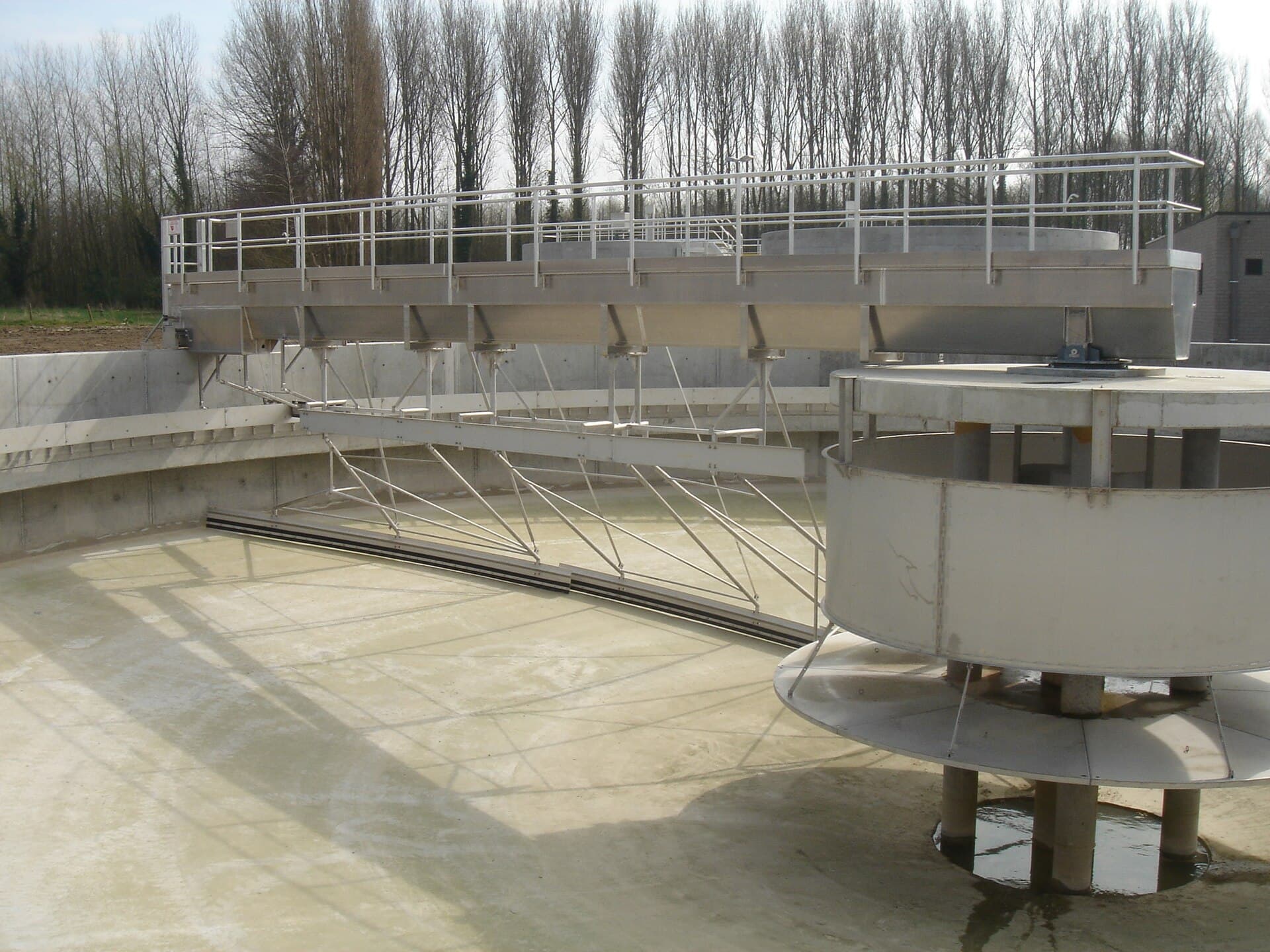
A basin designed to slow flow so suspended solids can settle.
Operator context: Clarifiers appear in both drinking-water and wastewater treatment, but the operating goals differ by process.
A storage basin for treated water, often used to provide disinfection contact time and operational storage.
Operator context: Operators consider clearwell level, baffling, turnover, and security because clearwells hold finished water.
The chemical destabilization of fine particles so they can come together during flocculation.
Operator context: Coagulation is usually a rapid-mix step; operators adjust coagulant dose based on turbidity, color, pH, and jar tests.
Chlorine that has reacted with ammonia or nitrogen compounds to form chloramines.
Operator context: Combined residual is more persistent but less powerful than free chlorine.
A measure of water's ability to conduct electricity, related to dissolved ions.
Operator context: Conductivity can help operators spot source changes, chemical feed issues, or industrial discharges.
The time water stays in contact with a disinfectant before reaching the first customer or compliance point.
Operator context: Contact time is part of CT calculations and depends on tank volume, flow, baffling, and usable volume.
Treatment practices used to reduce pipe corrosion and metal release into water.
Operator context: Operators may adjust pH, alkalinity, inhibitors, or blending to protect distribution piping and plumbing.
The product of disinfectant concentration and contact time.
Operator context: CT is used to judge whether disinfection conditions meet required pathogen inactivation targets.
The process of inactivating disease-causing organisms.
Operator context: Disinfection may use chlorine, chloramines, ozone, UV, or other methods depending on the facility and permit.
The short period after backwash when a filter stabilizes before producing its best water quality.
Operator context: Plants may use filter-to-waste or return-to-service rules to avoid sending high-turbidity water forward.
Water that has completed treatment and is ready for distribution.
Operator context: Finished water monitoring focuses on turbidity, residual, pH, corrosion control, and regulatory compliance.
Clumps of particles formed after coagulation and gentle mixing.
Operator context: Good floc is large and settleable enough to remove in clarifiers or filters without breaking apart.
Gentle mixing that brings destabilized particles together into larger floc.
Operator context: Too little mixing forms weak floc; too much mixing can shear floc apart.
Chlorine present as hypochlorous acid or hypochlorite ion, available for disinfection.
Operator context: Free chlorine is usually stronger and faster acting than combined chlorine.
The loss of pressure or energy as water moves through pipes, valves, media, or equipment.
Operator context: Rising filter headloss often signals solids buildup and can trigger backwash.
A chlorine chemical commonly used for disinfection, such as sodium hypochlorite or calcium hypochlorite.
Operator context: Operators handle hypochlorite carefully because strength decays and it can react with acids or incompatible chemicals.
A bench test used to estimate chemical dose and treatment response before changing full-scale operation.
Operator context: Jar tests are especially useful when raw water turbidity, color, temperature, or alkalinity changes.
A filtration process using membranes to separate particles, organisms, or dissolved materials.
Operator context: Operators track pressure, flux, cleaning cycles, integrity, and fouling.
An instrument that measures turbidity by detecting light scattered by particles.
Operator context: Filter performance and compliance often depend on reliable nephelometer readings.
Nephelometric turbidity unit, the common unit for measuring turbidity.
Operator context: Low NTU values indicate clearer water and are central to filtration performance.
A chemical reaction in which a substance loses electrons.
Operator context: Operators use oxidation for disinfection and for treating iron, manganese, taste, odor, or sulfide problems.
A measure of how acidic or basic water is.
Operator context: pH affects coagulation, corrosion, chlorine effectiveness, nitrification, and many chemical reactions.
A granular-media filter that removes particles after coagulation, flocculation, and sedimentation.
Operator context: Operators monitor effluent turbidity, headloss, filter run time, and backwash quality.
Source water before treatment.
Operator context: Raw water quality drives treatment choices, chemical dose, monitoring, and seasonal adjustments.
Flow passing through a tank or basin faster than intended because it bypasses effective volume.
Operator context: Short-circuiting reduces settling or contact time and can be improved with baffling.
A liquid chlorine solution commonly used for disinfection.
Operator context: It is easier to feed than chlorine gas but degrades with time, heat, light, and contamination.
The sum of free chlorine and combined chlorine residual.
Operator context: Operators compare free and total chlorine to understand whether disinfectant is present as free chlorine or chloramines.
Cloudiness caused by suspended particles that scatter light.
Operator context: Turbidity is a key filtration and water quality indicator because particles can interfere with disinfection.
A level overflow structure used to control or measure flow from a basin or channel.
Operator context: Uneven weir flow can reduce clarifier performance and create short-circuiting.
A measure of particle surface charge related to how particles repel or attract each other.
Operator context: The concept helps explain why coagulants make small particles form settleable floc.
19 terms
A physical vertical separation between a water outlet and a possible source of contamination.
Operator context: Air gaps are one of the simplest and most reliable ways to prevent backflow.
The unwanted reverse flow of non-potable water or contaminants into a potable water system.
Operator context: Operators protect against backflow with air gaps, assemblies, inspections, and cross-connection control programs.
A backflow condition where downstream pressure exceeds supply pressure.
Operator context: Boilers, pumps, elevated tanks, and pressurized process equipment can push contaminated water backward if protection is missing.
A backflow condition caused by negative or reduced pressure in the water main.
Operator context: Main breaks, hydrant use, or pump shutdowns can create suction that pulls water from connected hazards.
Pump damage caused when vapor bubbles form and collapse inside the pump.
Operator context: Cavitation can sound like gravel in a pump and may be caused by low suction head, restrictions, or excessive pump speed.
A physical link between a potable water system and a possible source of contamination.
Operator context: Common examples include hose connections, irrigation systems, chemical feed systems, and fire lines.
A program to identify and protect connections that could contaminate potable water.
Operator context: Programs usually include surveys, assembly testing, records, enforcement, and customer education.
A water main with limited circulation because it terminates rather than looping back.
Operator context: Dead ends often need flushing because water age can rise and residual can fall.
The pipes, pumps, valves, tanks, meters, and hydrants that deliver finished water to customers.
Operator context: Operators manage pressure, residual, storage turnover, flushing, leaks, and customer service issues.
The water flow available for firefighting at hydrants or specific points in the system.
Operator context: Fire flow depends on pressure, pipe size, storage, pumps, hydrants, and system condition.
Energy in water expressed as a height, often in feet.
Operator context: Head helps operators understand pump performance, pressure, elevation, and hydraulic grade.
The planned opening of hydrants to move water through mains and remove sediment.
Operator context: Flushing can improve water age and residual, but operators must manage pressure, traffic, and customer notifications.
A line representing the height water would rise to based on pressure and elevation.
Operator context: Operators use the concept to understand pressure zones, tanks, pumps, and flow direction.
An area of a distribution system served within a specific pressure range.
Operator context: Pressure zones are managed with tanks, pumps, valves, and elevation to maintain service and protect pipes.
A graph showing how a pump performs at different flows and heads.
Operator context: Operators compare pump curves with system conditions to diagnose poor flow, cavitation, or wrong operating points.
A storage facility for raw or finished water.
Operator context: Reservoir operations affect pressure, water age, fire storage, emergency supply, and water quality.
Pressure measured when water is not flowing.
Operator context: Static pressure reflects elevation and hydraulic grade, but flowing pressure may be lower because of headloss.
The planned operation of valves to verify they work and record their condition.
Operator context: Exercising helps operators isolate main breaks and avoid discovering stuck valves during emergencies.
The time water spends in the distribution system after leaving treatment or storage.
Operator context: High water age can reduce disinfectant residual and increase taste, odor, and water quality complaints.
34 terms
A biological wastewater process that uses microorganisms to consume dissolved and suspended organic matter.
Operator context: Operators watch aeration, return sludge, wasting, settling, and dissolved oxygen because small process changes can affect permit results.
The process of adding air or oxygen to wastewater so aerobic organisms can treat organic waste.
Operator context: Too little air can cause poor treatment and odors; too much air wastes energy and may hurt settling.
A condition or process that occurs without dissolved oxygen.
Operator context: Anaerobic conditions can be useful in digestion but can also cause odors and septic wastewater in collection systems.
A low-oxygen condition where nitrate is available but dissolved oxygen is limited.
Operator context: Anoxic zones are used for denitrification in nutrient-removal systems.
A measure of the oxygen microorganisms need to break down biodegradable organic matter, commonly abbreviated BOD.
Operator context: High influent BOD means more treatment demand; high effluent BOD can indicate poor biological performance or solids carryover.
The common abbreviation for biochemical oxygen demand.
Operator context: BOD is one of the core wastewater permit and loading terms operators see in exams and daily process control.
Chemical oxygen demand, a measure of oxygen equivalent needed to chemically oxidize organic and inorganic material.
Operator context: COD results are faster than BOD and often used for process trending, industrial waste checks, and loading comparisons.
To draw off clarified liquid from above settled solids.
Operator context: Decanting is common in sludge handling, lagoon operation, and batch treatment processes.
The removal or neutralization of chlorine before discharge.
Operator context: Wastewater operators dechlorinate because chlorine residual can harm aquatic life and violate permits.
The biological conversion of nitrate to nitrogen gas under low-oxygen conditions.
Operator context: Denitrification can be useful for nutrient removal, but uncontrolled denitrification in clarifiers can cause floating sludge.
A tank where sludge is biologically stabilized.
Operator context: Operators monitor temperature, mixing, pH, alkalinity, gas, volatile acids, and safety around digesters.
The oxygen dissolved in water or wastewater, often abbreviated DO.
Operator context: In aeration basins, DO affects biological treatment; in receiving waters, low DO can stress aquatic life.
Water or wastewater leaving a treatment process, tank, plant, or unit.
Operator context: Operators compare influent and effluent quality to evaluate treatment effectiveness and permit compliance.
Food-to-microorganism ratio, a process-control measure comparing organic loading to biomass.
Operator context: The F/M ratio helps operators understand whether the biomass is underloaded, overloaded, or in a stable range.
Temporary storage or flow control used to smooth out peaks before treatment.
Operator context: Equalization helps plants handle surges from storms, industries, or daily flow patterns.
Water or wastewater entering a plant, process, or unit.
Operator context: Influent flow and strength help operators anticipate loading and treatment changes.
Mean cell residence time, an estimate of how long microorganisms remain in the activated-sludge system.
Operator context: MCRT is closely related to sludge age and helps control nitrification, solids inventory, and wasting.
The mixture of wastewater and activated sludge in an aeration basin.
Operator context: Mixed liquor tests help operators judge biomass concentration and process health.
Mixed liquor suspended solids, the suspended solids concentration in an aeration basin.
Operator context: MLSS helps operators track the amount of biomass available for treatment.
Mixed liquor volatile suspended solids, an estimate of the organic portion of mixed liquor solids.
Operator context: MLVSS is often used as a closer estimate of active biomass than total MLSS.
The biological conversion of ammonia to nitrite and nitrate.
Operator context: Nitrification needs enough oxygen, alkalinity, temperature, and sludge age to stay stable.
The amount of biodegradable material entering a process, often expressed as pounds of BOD per day.
Operator context: Organic loading helps operators match aeration, biomass, and wasting to the incoming waste strength.
Physical wastewater treatment that removes settleable and floatable solids.
Operator context: Primary clarifiers reduce load on downstream biological treatment.
Return activated sludge, the settled biomass pumped from secondary clarifiers back to aeration.
Operator context: RAS rate affects clarifier sludge blanket, mixed liquor concentration, and biological stability.
A clarifier that separates biological solids from treated wastewater after aeration.
Operator context: Operators watch sludge blanket depth, solids loading, RAS, wasting, and signs of rising sludge.
Biological treatment that removes dissolved and fine organic material after primary treatment.
Operator context: Activated sludge, trickling filters, and lagoons are common secondary treatment processes.
Waste pumped from septic tanks and hauled to a treatment or receiving facility.
Operator context: Septage can be strong, odorous, and variable, so plants control receiving and loading carefully.
How well suspended solids settle under test or process conditions.
Operator context: Poor settleability can cause solids loss, high effluent TSS, and clarifier problems.
An estimate of how long solids remain in an activated-sludge system.
Operator context: Sludge age guides wasting decisions and affects settling, nitrification, and process stability.
The layer of settled solids at the bottom of a clarifier.
Operator context: A rising blanket can warn operators about poor settling, low RAS, hydraulic overload, or denitrification.
Sludge volume index, a settling indicator for activated sludge.
Operator context: High SVI often points to poor settling or bulking; low SVI can indicate dense, fast-settling sludge.
Total suspended solids, the solids retained by a filter during laboratory testing.
Operator context: TSS is a common wastewater permit parameter and a key indicator of clarifier performance.
The portion of solids that burns off during a laboratory test, often used as an estimate of organic matter.
Operator context: Volatile solids help operators evaluate sludge digestion and biomass characteristics.
Waste activated sludge, the biomass intentionally removed from the activated-sludge process.
Operator context: Wasting controls solids inventory, sludge age, and treatment stability.
16 terms
Camera inspection of sewer pipes to identify defects, roots, blockages, and structural issues.
Operator context: CCTV results help prioritize cleaning, repair, rehabilitation, and inflow/infiltration work.
The network of sewers, manholes, lift stations, and force mains that carries wastewater to treatment.
Operator context: Collection operators focus on blockages, inflow, infiltration, overflows, lift station reliability, and worker safety.
A sewer that carries both sanitary wastewater and stormwater in the same pipe.
Operator context: Heavy rain can overwhelm combined systems, making overflow control and wet-weather operations important.
The dry equipment room of a pump station, separate from the wastewater wet well.
Operator context: Dry wells can contain pumps, valves, piping, and electrical equipment but may still have atmospheric hazards.
A level-sensing device that starts, stops, or alarms pumps based on liquid level.
Operator context: Lift station operators test floats because failures can lead to pump damage or overflows.
Fats, oils, and grease in wastewater.
Operator context: FOG can build up in sewers, restrict flow, cause odors, and contribute to sanitary sewer overflows.
A pressurized sewer pipe that carries wastewater from a pump or lift station.
Operator context: Force mains require attention to air release, pressure, corrosion, odors, and failure response.
A sewer that carries wastewater by slope rather than pressure.
Operator context: Proper grade, cleaning, and infiltration control help gravity sewers avoid blockages and overflows.
Groundwater entering a sewer system through defects, cracks, joints, or manholes.
Operator context: Infiltration increases treatment load and can contribute to overflows during wet conditions.
Stormwater or surface water entering sewers through direct connections or openings.
Operator context: Roof drains, sump pumps, open cleanouts, and leaky manholes can add large wet-weather flow quickly.
A pumping facility that raises wastewater from a lower elevation to a higher sewer or force main.
Operator context: Operators inspect pumps, floats, wet wells, alarms, backup power, odor control, and confined-space hazards.
An access structure for inspecting and maintaining sewers.
Operator context: Manhole inspection can reveal inflow, infiltration, corrosion, surcharge marks, and structural defects.
The change in pipe elevation over distance.
Operator context: Gravity sewers need enough slope to maintain velocity without causing excessive erosion.
A flow velocity high enough to move settled solids through a sewer.
Operator context: Low velocities allow deposits to build up; adequate cleaning and slope help prevent stoppages.
A condition where wastewater rises above the normal flow depth in a sewer or manhole.
Operator context: Surcharging can indicate blockage, capacity limits, inflow, infiltration, or downstream restrictions.
The chamber in a lift station where wastewater collects before pumping.
Operator context: Wet well level controls pump starts and stops, but the space can contain toxic or explosive atmospheres.
8 terms
The theoretical time water or wastewater remains in a tank or basin.
Operator context: Operators calculate detention time from volume and flow to understand mixing, settling, contact, and treatment performance.
The amount of chemical applied to a water or wastewater flow, often in mg/L.
Operator context: Dose calculations connect flow, chemical strength, feed rate, and desired treatment result.
Gallons per day, a flow unit used for daily water or wastewater volumes.
Operator context: Small systems, dosing pumps, and permit reports often use GPD or MGD depending on scale.
Gallons per minute, a common flow-rate unit.
Operator context: Operators use GPM for pumps, hydrant flows, filters, chemical feed, and many exam calculations.
The amount of flow applied to a treatment unit or surface area.
Operator context: High hydraulic loading can reduce settling, filtration, or biological treatment performance.
Million gallons per day, a standard unit for plant flow.
Operator context: MGD is common in loading, detention time, chemical dosage, and permit calculations.
The highest flow rate during a selected period.
Operator context: Peak flows matter for pumps, sewers, clarifiers, filters, chemical feed, and wet-weather planning.
Flow divided by the length of a clarifier weir.
Operator context: This loading rate helps operators evaluate whether a clarifier is hydraulically stressed.
5 terms
A group of bacteria used as indicators of possible contamination.
Operator context: Coliform monitoring is central to distribution-system bacteriological compliance and response procedures.
A sample made by combining smaller samples over time or flow.
Operator context: Composite samples can better represent average wastewater or process conditions than one grab sample.
A space large enough to enter, not designed for continuous occupancy, and limited in entry or exit.
Operator context: Manholes, wet wells, tanks, and vaults require atmospheric testing, ventilation, permits when required, and rescue planning.
A single sample collected at one time and place.
Operator context: Grab samples are useful for quick checks or conditions that change rapidly, such as chlorine residual or pH.
A legal maximum, minimum, or range that a facility must meet.
Operator context: Operators use permit limits to guide monitoring, process control, reporting, and response decisions.